SOA OS23: Understanding Its Role and Importance in Modern Digital Systems

What Is SOA OS23?
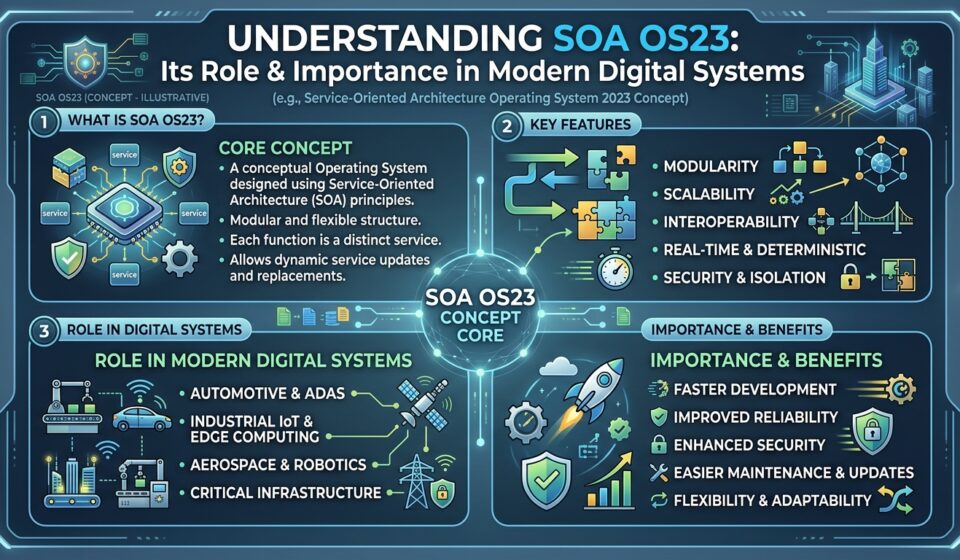
OS23 is often discussed in relation to service-oriented approaches that emphasize efficient communication between systems and applications. The concept centers on enabling different software components to work together while maintaining flexibility and independence. In modern organizations, multiple applications often support various business functions, making seamless integration essential. SOA reflects the need for structured frameworks that simplify these interactions. By encouraging organized communication and efficient data exchange, such systems help organizations improve operational effectiveness. Understanding the foundations of SOA can provide businesses with a clearer perspective on achieving better connectivity and performance.
The Evolution of Service-Oriented Technologies
The development of service-oriented technologies emerged from the growing complexity of enterprise software environments. As organizations expanded their digital infrastructure, traditional systems often struggled to communicate effectively. Service-oriented models were introduced to address these challenges by enabling modular and reusable software services. SOA represents a continuation of this evolution, emphasizing adaptability and efficient integration. Over time, technological advancements have improved the ability of systems to exchange information quickly and securely. This ongoing progression reflects the increasing importance of flexible architectures capable of supporting modern business requirements and rapidly changing technological landscapes.
Why SOA OS23 Matters in Modern Organizations
Organizations today rely on numerous digital platforms to manage operations, customer interactions, and data processing. Without effective integration, these systems can become isolated, reducing productivity and creating inefficiencies. SOA addresses these challenges by promoting coordinated communication among various software components. This approach enables organizations to streamline workflows and improve information accessibility across departments. Enhanced connectivity supports faster decision-making and more efficient resource utilization. As businesses continue embracing digital transformation, frameworks like SOA become increasingly valuable. Their ability to improve operational consistency and system collaboration contributes directly to organizational success and long-term competitiveness.
Key Benefits of SOA OS23 Implementation
One of the most significant advantages of SOA is its ability to improve flexibility within digital environments. Organizations can modify or update specific services without disrupting entire systems, reducing operational risk and maintenance complexity. This modular structure also supports scalability, allowing businesses to expand technology resources as requirements evolve. Improved integration enhances data sharing and operational efficiency across different departments. Additionally, SOA OS23 can help reduce development costs by encouraging service reuse and minimizing redundant processes. These benefits make it an attractive solution for organizations seeking greater agility, efficiency, and technological resilience.
SOA OS23 and Digital Transformation
Digital transformation requires organizations to adapt quickly to evolving market demands and technological advancements. SOA OS23 supports this transition by providing a framework that encourages seamless integration and efficient communication between systems. Businesses undergoing digital transformation often face challenges related to legacy software and fragmented processes. Service-oriented approaches help overcome these obstacles by connecting existing resources with modern technologies. Through improved interoperability and streamlined workflows, organizations can accelerate innovation and enhance customer experiences. SOA OS23 aligns with the broader objectives of digital transformation by enabling greater adaptability and supporting sustainable technological growth.
The Role of SOA OS23 in Data Management
Data serves as one of the most valuable assets within modern organizations. Effective data management requires systems capable of collecting, processing, and distributing information efficiently. SOA OS23 contributes to these goals by facilitating structured communication between applications and databases. This connectivity helps ensure that information flows smoothly across organizational functions. Improved data accessibility supports more informed decision-making and enhances operational transparency. As businesses generate increasing amounts of information, the need for reliable integration frameworks becomes more important. SOA OS23 provides a foundation that helps organizations manage data effectively while maintaining consistency and accuracy throughout their operations.
Security Considerations in SOA OS23 Environments
Security remains a critical concern whenever multiple systems exchange information. SOA OS23 environments require careful planning to protect sensitive data and maintain secure communication channels. Organizations often implement authentication protocols, access controls, and monitoring systems to strengthen security measures. Effective governance helps ensure that services operate within established compliance and security standards. While increased connectivity offers numerous benefits, it also introduces potential vulnerabilities that must be managed responsibly. By incorporating strong security practices into implementation strategies, businesses can maximize the advantages of SOA OS23 while reducing risks associated with digital integration and information sharing.
Challenges Associated With SOA OS23 Adoption
Although SOA OS23 offers significant benefits, organizations may encounter challenges during implementation. Integrating diverse systems often requires careful planning, technical expertise, and ongoing management. Legacy infrastructure can present compatibility issues that complicate deployment efforts. Additionally, maintaining consistent governance across multiple services may require dedicated resources and oversight. Despite these challenges, many organizations find that the long-term benefits outweigh initial complexities. Strategic planning and effective project management can help address implementation obstacles. Understanding potential challenges allows businesses to develop realistic expectations and create successful adoption strategies that maximize the value of SOA OS23.
The Future of SOA OS23 in Technology
The future of SOA OS23 appears promising as organizations continue seeking solutions that support flexibility, scalability, and innovation. Emerging technologies such as cloud computing, artificial intelligence, and advanced automation increasingly rely on interconnected systems. Service-oriented approaches provide a strong foundation for integrating these technologies efficiently. As digital ecosystems become more complex, the principles associated with SOA OS23 are expected to remain highly relevant. Continued advancements in integration tools and communication standards will likely enhance its capabilities further. Organizations that embrace adaptable architectures will be better positioned to respond to future technological opportunities and challenges.
Conclusion
SOA OS23 represents an important concept in modern technology, emphasizing connectivity, flexibility, and efficient system integration. Its role in supporting digital transformation, data management, operational efficiency, and scalable growth highlights its significance for contemporary organizations. By enabling seamless communication between software services, SOA OS23 helps businesses improve performance while adapting to evolving technological demands. Although implementation may present certain challenges, the long-term benefits often justify the investment. As technology continues advancing, the principles associated with SOA OS23 will remain valuable for organizations seeking innovative, reliable, and future-ready digital solutions.
Tags:
soa os23
saif abbasi
Saif Abbasi is a content writer for Americas Best, covering everything from current trends to everyday tips. He believes in the power of clear communication and strives to create content that resonates with a diverse digital audience.